

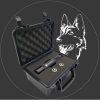
Laser K9 – remote indication for detection
Laser K9 – remote indication for detection
A laser to indicate your goals to your dog
Achtergrond van het trainen van honden met de Laser K9 – externe aanduiding voor detectie
Thanks to technological progress and the resulting ever more powerful and robust laser systems, they can now also be used for many applications in technically hostile environments (dirt, water, dust, heat, cold).
One such application area has recently entered the training curriculum and for the training of search, hunting, rescue, protection and assistance dogs.
De laser K9 kan worden gebruikt om objecten en posities binnen het gezichtsveld van de manipulator specifiek te markeren.
De laser K9 geeft de hond een visuele stimulans en kan zo nauwkeurig over lange afstanden worden geleid.
Het voordeel van werken met lasers K9 is dat je weg bent van de hond terwijl hij de eigenlijke taak uitvoert.
This applies in particular if there is a danger to persons, objects to be found (e.g. evidence) or if access to persons is denied due to environmental conditions. For example, in the event of a disaster or the presence of obstacles.
Depending on the specification of the laser, close objects as well as distant objects can be visibly marked and thus become an instinctive target for the dog.
Belangrijke aspecten van hondentraining zijn de flexibiliteit van de laser K9 in relatie tot verschillende afstanden en doelen, evenals oogveiligheid voor mens en dier, met altijd goed zicht.

OPMERKINGEN Laser K9 – externe aanduiding voor detectie:
The laser light must be visible to both humans and dogs. In determining the optimal wavelength, the anatomy and evolutionary development of the eye are particularly important.
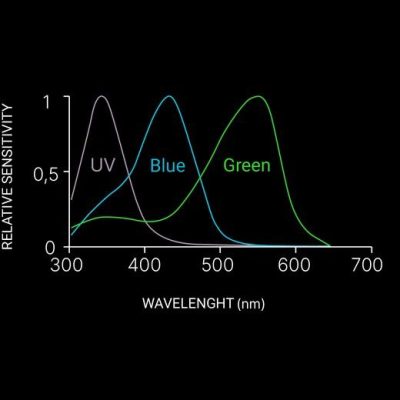
Most mammals are dichromats [1, 2, 3] and have only 2 types of cones:
- a cone whose sensitivity is in the shortwave range of the spectrum and which corresponds to the human blue cone.
- a cone that is most sensitive to long-wavelength light (photo 2)
The visual pigments of these two types of cones are accordingly designated as SWS1 (“short sensitive wavelength 1”) and LWS (“long sensitive wavelength”).
During evolution, about 30 million years ago, the red cone arose within the human species through a duplication and subsequent mutation of the gene responsible for the visual pigment of the green cone lumbar spine in other mammals.
The green cone appears twice in humans, so to speak, with the visual pigment sensitivity of the lumbar spine of one of these cones being shifted to longer wavelengths (perceived as red by humans).
This results in up to ten times better visibility of the green wavelength spectrum in humans than red.
De gemeenschappelijke interface bij het selecteren van een geschikte laser K9, zodat zowel honden als mensen deze goed kunnen herkennen, is het golflengtebereik van ongeveer 500-600 nm.
Technically, 520 nm diodes are ideal because they are also more resistant to external influences than the 532 nm lasers used so far.
Once the dog has arrived at the marked position, it may engage in a previously conditioned behavior. Working dogs are used by law enforcement, special forces, as well as commercial dog trainers around the world to find all kinds of substances and odors. These include personal sniffer dogs, dogs used by the police and military to find drugs, explosives or evidence, wildlife sniffer dogs and dogs used for hunting.
The use and training of these dogs and the associated autonomous search work disconnected from the handler requires clear criteria for the task at hand, as well as intensive training from the start.
Toepassingsgebieden met de Laser K9 – externe aanduiding voor detectie
The management of dogs is currently done mainly through the use of poor quality lasers that are not approved and can be ordered cheaply on the Internet.
With these lasers, the output power is usually well above the permitted limits.
In addition, the classification according to DIN EN 60825-1 usually does not correspond to the specified parameters, so that there is a significant risk potential for the health of the user.
Among law enforcement and commercial users, these lasers have long been under the scrutiny of laser safety officials because of their danger.
The durability and constancy of power of these lasers fluctuate in different temperature ranges and make the use of lasers an incalculable danger to the eyes of humans and animals. Laser protection is often overlooked by professional dog trainers and dog schools because of the danger of inconsistent light coming from the laser.
The emitted light and haptics of these mass-produced lasers are therefore not suitable for use in dogs. For dog training it is recommended to use a high quality, accurate and safety compliant laser. Performance and features may be higher or lower, depending on the application, to account for distances and environmental conditions – as well as tactical conditions if necessary. Ideally this can be done via different switchable modes and mechanical fuses to prevent accidental activation of the high output.
De Laser K9 – externe aanduiding voor detectie vult dit gat, het is een hoogwaardige laser speciaal ontworpen voor trainingsprogramma’s en voor het trainen van detectie-, jacht-, reddings-, beschermings- en hulphonden.
When training dogs, the work is initially limited to short distances and in dark lighting conditions, which should make it easier for the dog to see the light spot.
A neutral training environment should make it easier for the dog to see a target in the laser dot without being distracted by the environment, always in combination with a valuable reward as an instinctive target.
The use of a powerful laser not only harms the effect and fun at work, but also poses health risks for humans and animals during the training phase due to possible strong glare.
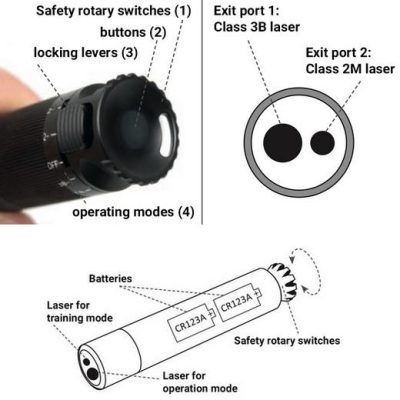
For this reason, this laser can be used in a safe training mode with reduced power and thus allows you to work comfortably with the dog.
A second mode has a flash rate of 8 Hz, which increases both the visual stimulus and the perception of the laser dot in humans and dogs. This takes advantage of the dog's better ability to detect movement.
This increased visibility of light reflection is evident even in difficult terrain, such as undergrowth.
The functionality of the laser is complemented by two other operating modes. For the full light output of the laser, e.g. for position indications over long distances in daylight or direct sunlight, the laser offers an “operating mode”.
This is secured by a special lock on the rotary switch, preventing accidental activation.
A variant with a flash frequency of 8 Hz is also integrated for this mode in order to adapt the laser as flexibly as possible to the respective task and the prevailing environmental parameters.
The different operating modes are powered by a common source to reduce production effort. In addition, the Laser K9 has a robust matte black anodized housing and is water, dust and shock resistant.
The desired mode is selected with a rotary switch and the setting mode is activated with an additional button. The K9 Laser is also designed to be used comfortably with winter gloves or protective gloves.
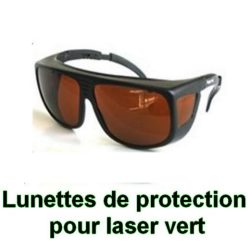
Other innovations such as cases, collapsible filters to reduce current, etc. allow the targeted use of a laser for remote guiding of dogs.
Hoe worden honden getraind met laserpointers? Laser K9 – externe aanduiding voor detectie
Honden reageren goed op het werken op afstand met behulp van een laser K9, wat resulteert in een goed gestructureerde training. De gewoonte om met de laserpunt te werken kan van hond tot hond verschillen. Dit vereist een goede observatie van de reactie van de hond en een goede timing bij het geven van de beloning.
Aan het begin van de training is het aan te raden bekende prikkels voor de hond te combineren met het nieuwe laserpunt zichtbaar op kortere afstand. Om schade aan de ogen te voorkomen, is het noodzakelijk om met een minimale lichtafgifte te werken – om veiligheidsredenen voor de mens, en vooral voor de hond, omdat deze zich dichter bij het laserpunt bevindt om de betreffende taak te volbrengen en ook omdat hij zou kunnen kijk direct in de balk.
Mogelijke reflecties van bepaalde oppervlakken vormen ook een risico op verblinding door verstrooide straling. Ook moet er rekening gehouden worden met een versterking van dit effect in het donker, aangezien de pupillen van mens en dier groter zijn en de kans op letsel groter is.
Another method of drawing the dog's attention to the laser's light stimulus is to move the dot itself. This can be generated manually by moving the user's hand – or technically by a flash function of the laser. Het is raadzaam om, afhankelijk van het doel van het werken op afstand, vooraf te analyseren hoeveel prikkels de hond nodig heeft om het specifieke doel te bereiken.
Als de hond bijvoorbeeld bij het markeringspunt iets moet pakken en terughalen, kan dit gepaard gaan met een beloning die training bevordert (speelgoed, eten).
Het principe van conditionering is de combinatie van acties door subdoelen te vormen – beginnend met het gewenste gedrag en vervolgens de afstand vergroten. Alle trainingsvarianten kunnen eenvoudig worden geïntegreerd in een bijbehorend lasertrainingsontwerp, dat altijd individueel wordt aangepast aan de betreffende hond en wordt uitgebreid tot de gewenste afstand.
Afhankelijk van doel, hoogte, afstand of omgevingscondities kunnen de stimuluswaarde en omgevingscondities naar believen worden gewijzigd.
Tips voor het trainen van honden met de Laser K9 – externe aanduiding voor detectie:
- Depending on the purpose of remote work, analyze the amount of stimulus the dog needs to complete the task.
- Link task completion to a resource that promotes commitment (toys, food, etc.).
- When learning complex tasks, the link aids in the behavior that takes place once the laser point is reached. This behavior is then the “reward”. After returning to the handler, the dog receives the “correct” reward (food, treats).
- Start by training the dog over short distances and in a dark environment so that the laser contrasts clearly with the environment.
- Provide a low-stimulus environment so that the dog is not distracted by other sounds or light.
- In a neutral setup, the dog should understand the meaning of the laser dot without any distractions from the environment.
De Laser K9 – externe aanduiding voor detectie is leverbaar in twee uitvoeringen:
- Type1: Laser K9
- Type2: Laser K9 with mounting ring for Picatiny